Firm gas on the design day.
Fewer parts to fail getting it there.
A peak shaver earns its keep on a handful of the coldest days of the year. GreenER™ Technology (U.S. Patent No. 12,455,047 B2) stores LNG in shop-built tanks and moves it by controlled tank pressure, with no extraction pumps and no penetrations through the bottom of the tank. Less to maintain all year. Less to go wrong the one morning it matters.
What changes for a utility
One design decision, pressure build doing the work, is behind every item below.
No extraction pump to fail on the design day
Controlled tank pressure moves the LNG. There is no cryogenic pump in the withdrawal path, so there is no pump to prime, rebuild or schedule around when the coldest morning of the year arrives.
No bottom penetrations, no annual shutoff-valve testing
Under 49 CFR 193.2619(c), internal shutoff-valve controls on bottom-penetration tanks are tested every year. A GreenER™ tank has no bottom penetration and no such valve, and it can assume a 10-minute design spill instead of the full tank volume.
Smaller impoundment, tighter exclusion zones
Removing the pipe through the floor removes the release a conventional tank has to model. The impoundment shrinks or goes away, and both PHMSA exclusion zones pull in. Every site is still modeled on its own.
Shop-built, delivered by rail, added in steps
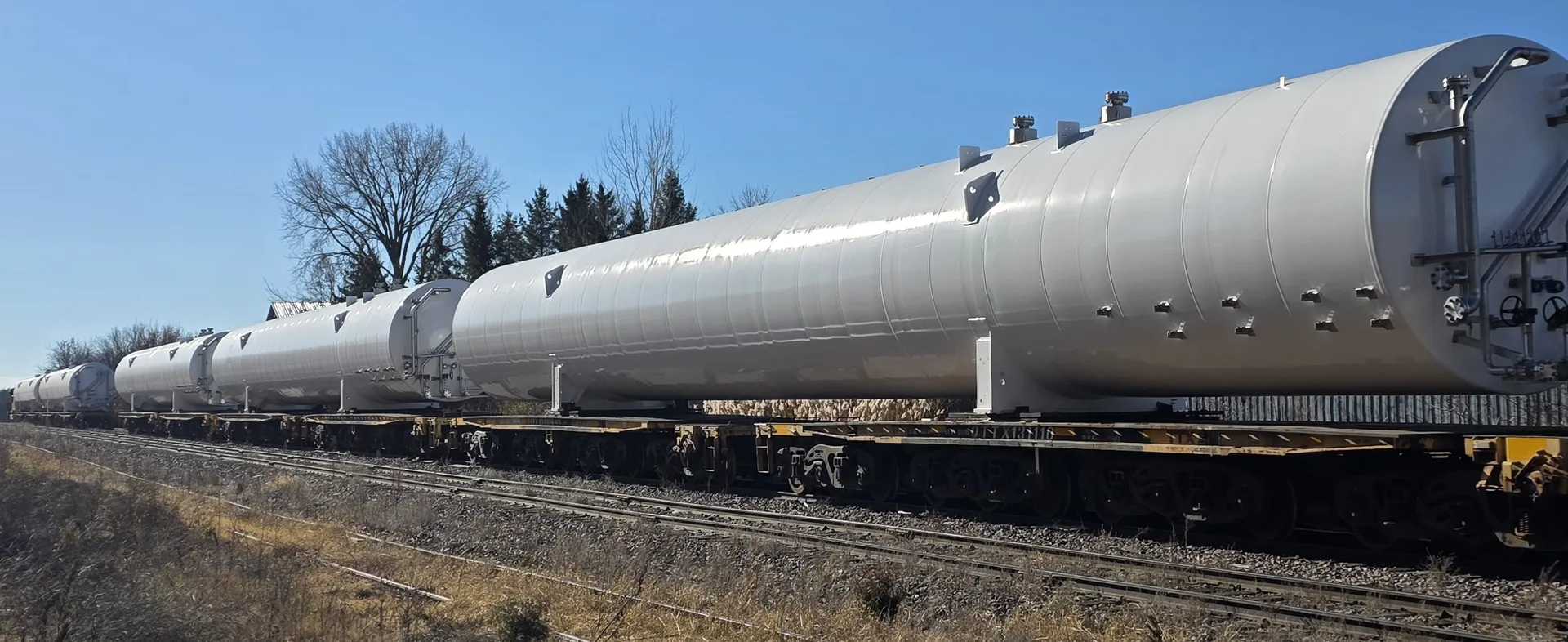
Tanks are built in a factory and shipped finished. Total system fabrication can be as early as 9 months, several licensed fabricators can build them, and inventory can grow a tank at a time as load grows.
Running and shipping today
At Greenville Utilities, two of six 77,000-gallon tanks and the GreenER™ pressurization system are in commercial operation, moving LNG by pressure with no in-tank pumps. Two utilities have ordered the full system.
A separate order of five 77,000-gallon tanks is loaded on a single train for a utility customer in the Southeast. It may be the largest single rail shipment of LNG storage tankage ever, though that has not been confirmed.
How a project comes together
- 1 Origination. Site, demand basis and the commercial case.
- 2 Permitting and FEED. Siting under 49 CFR 193 and NFPA 59A, then front-end design.
- 3 EPC wrap. One accountable path through engineering, procurement and construction.
- 4 Build and commission. Shop-built tanks delivered, set and started up.
- 5 Commercial operations. Operator training, readiness and optimization.
We can develop the facility, deliver it under an EPC wrap, or license GreenER™ Technology to your EPC and fabricator.
The utility technical brief
The nozzle architecture, transfer-rate sizing, the 49 CFR 193 comparison against a bottom-penetration tank, the full value comparison against pumped storage, and the tank range. It sits behind an access code. If you were given a code, sign in. If not, ask us for one.
U.S. Patent No. 12,455,047 B2 · U.S. Provisional Patent Application No. 63/991,359