What Is LNG Peak Shaving, and Why Utilities Need It
How peak shaving lets a gas utility meet winter demand spikes without paying for year-round pipeline capacity it uses a few weeks a year.
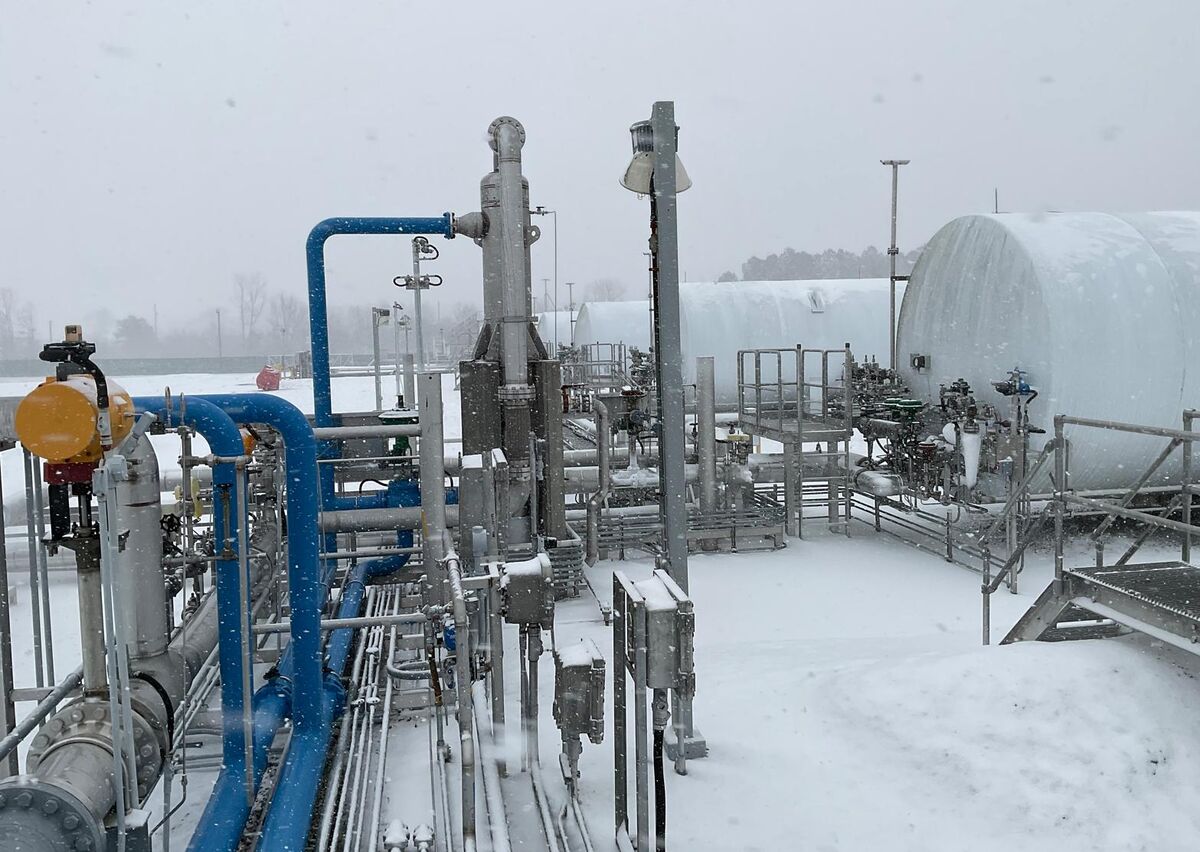
Peak shaving is how a natural gas utility meets short-duration winter demand spikes, the coldest hours of the coldest days of the year, without paying for year-round pipeline capacity it only needs a few times a season. The most common implementation is on-site LNG storage: gas is liquefied, stored at cryogenic temperatures during normal operating periods, and vaporized back into the distribution system on design-day cold snaps when pipeline supply alone can’t keep up.
That’s the one-paragraph version. The longer version is where the engineering and the economics get interesting, and where the calculus has shifted enough in 2026 that peak shaving is being reconsidered by utilities that haven’t touched the topic in twenty years.
Why “peak shaving” exists at all
A natural gas distribution system has to deliver firm gas every hour of every day, including the few hours per year when demand is at its absolute maximum. That maximum is called the design-day load, and on most U.S. local distribution systems the design-day load is meaningfully larger than the system’s average winter day, often by a factor of 1.5x to 3x, depending on heating degree-day exposure.
A utility has three real options for meeting design-day demand:
- Buy enough firm pipeline capacity to cover the peak. This is the most expensive option because firm transportation contracts are priced on the peak hour, not the average. The utility ends up paying for capacity it sits on for most of the year.
- Buy interruptible or “released” pipeline capacity. Cheaper, but it isn’t firm. And design days are exactly when interruptible capacity is most likely to be curtailed.
- Store gas locally and vaporize it on demand. This is peak shaving. The most common storage medium for this kind of short-duration, high-deliverability service is LNG, because cryogenic liquefaction shrinks the volume of natural gas roughly 600-to-1, a fraction of the footprint of an equivalent salt cavern, line pack, or above-ground gas holder.
Peak shaving is, in other words, a build-vs-buy decision against pipeline capacity. The math depends on the spread between firm transportation cost on the peak day and the all-in levelized cost of building and operating a peak-shaver. When pipeline expansion is constrained, whether by permitting timelines, FERC certification queues, community opposition, or interstate-vs-intrastate jurisdictional friction, the build-side of that equation gets steadily more attractive.
How an LNG peak-shaver actually works
A peak-shaving LNG facility has four major process blocks:
- Liquefaction. A small electric- or gas-driven liquefier takes pipeline gas in, removes water and CO₂ in pretreatment, chills the cleaned gas through a cryogenic refrigeration loop, and produces LNG at roughly -260°F. Liquefiers at peak-shaving scale are deliberately small relative to merchant export plants. The goal is to slowly fill storage over weeks and months, not to produce LNG for sale.
- Cryogenic storage. LNG is held in vacuum-insulated bullet tanks or insulated flat-bottom tanks designed to API 620 for low-temperature, low-pressure service, sited inside the exclusion zones required by 49 CFR 193 (the federal LNG facility safety standard).
- Send-out / vaporization. When the system needs gas, LNG leaves the tank, gets warmed back to gaseous natural gas through ambient-air or shell-and-tube vaporizers, and re-enters the distribution system. Vaporizer capacity is sized to design-day send-out, not annual throughput. The facility is built for deliverability, not for total energy stored.
- Pressurization. Something has to push LNG out of the tank into the vaporizer train. Traditional designs use submerged cryogenic pumps inside the tank; pressure-build designs (including the GreenER™ approach used at the Greenville Utilities project) use a controlled vapor-pressure differential instead.
The economics of peak shaving live almost entirely in capacity terms (gallons of LNG stored and MMBtu/day or MMSCF/day of send-out) rather than in throughput. A peak-shaver that runs hard for 30 days a year and idle the other 335 is a perfectly normal operating profile.
Who needs to care about peak shaving in 2026
The 2026 conversation around peak shaving is being driven by four forces that didn’t all exist together a decade ago:
- Pipeline expansion has gotten harder, slower, and more contested. New interstate gas pipeline certifications have been measured in years, sometimes the better part of a decade, and several major projects have been canceled outright after substantial capital expenditure. For a utility looking at design-day exposure five to ten years out, “we’ll just expand the pipe” is not the default answer it used to be.
- Electrification policy is pushing peak heating loads, not flattening them. Even in jurisdictions actively electrifying space heat, the gas system still has to serve a peak-day load on the customers that remain, and that load doesn’t decline linearly with the customer count. Heat pump backup, dual-fuel arrangements, and industrial process load mean the design-day shape is, in some service territories, getting peakier rather than smoother.
- Data center load is reshaping which utilities need firm gas where. Behind-the-meter natural gas generation for data centers, particularly in regions where the grid interconnect queue is years long, is creating new firm-gas demand outside the traditional LDC heating profile. Some of that demand is being met with on-site LNG storage and vaporization, which is functionally a peak-shaving design applied to a different load profile.
- The U.S. Energy Information Administration tracks roughly 169 peak-shaving facilities across the country, most of them built between the 1960s and the 1990s. A meaningful fraction of that fleet is approaching end-of-design-life or is being relicensed under updated 49 CFR 193 requirements. That means a wave of repower-or-replace decisions is in front of utility planners over the next decade. (See the U.S. EIA’s natural gas infrastructure data for the public dataset on existing peak-shavers and pipeline capacity.)
Put those four together, and peak shaving is no longer a settled, mature segment. It’s an active build-or-replace conversation at gas utilities, IPPs, EPCs, and the family-office capital allocators that finance them.
Regulatory note — peak shaving lives inside a tightly bound rule set
Because LNG storage involves cryogenic hazards, federally regulated facility siting, and rate-recoverable utility capital, every peak-shaving project is built on top of a stack of standards. The most important ones to know by name:
- 49 CFR 193: the federal LNG facility safety standard administered by the Pipeline and Hazardous Materials Safety Administration (PHMSA). Governs siting, exclusion zones, materials, and operations.
- NFPA 59A: the National Fire Protection Association standard for the production, storage, and handling of LNG. 49 CFR 193 incorporates portions of 59A by reference.
- API 620: the design rule for low-pressure, low-temperature welded storage tanks. Peak-shaving LNG storage at utility scale is almost universally an API 620 vessel.
- API 610: the centrifugal pump specification used in petroleum, petrochemical, and natural gas service, relevant to any pumps used downstream of vaporization or in transfer applications.
- State public utility commission rate-base rules: peak-shaving capital is typically rate-base eligible in state-regulated LDC service. The cost-of-service treatment varies by jurisdiction.
The regulatory implication is straightforward: peak-shaving project schedules are dominated by permitting and exclusion-zone work, not fabrication. A design that minimizes 49 CFR 193 exclusion-zone area or simplifies the tank’s pressure-relief pathway tends to compress the front end of the project schedule by months. That is a real economic effect, not a marketing claim.
What “good” peak shaving looks like operationally
A well-built peak-shaver runs almost invisibly. Liquefier slowly tops up storage during shoulder seasons, send-out activates on cold-day forecasts, vaporizer trains warm up, gas enters the distribution system, and the utility’s gas dispatch operators see a flat-as-possible delivery pressure on the downstream side regardless of what the LNG inventory is doing.
The operational metrics that matter:
- Inventory carry cost: boil-off losses, pretreatment energy, and liquefier electricity over the storage period.
- Design-day deliverability: how much send-out, in MMSCF/day, the facility can actually produce on the worst hour of the worst day. Permitted send-out and physical send-out are not always identical.
- Permitting risk profile: exclusion zones, PHMSA inspection findings, and any open compliance items at the state level.
- Maintenance schedule: for designs that include rotating equipment (cryogenic pumps, recip compressors), the maintenance window has to fit between heating seasons. Designs without rotating equipment relax that constraint.
If you’re a utility VP, an EPC procurement lead, or a capital allocator looking at gas-infrastructure assets, those four metrics are where the operating reality of a peak-shaver lives. Marketing-grade throughput numbers are not.
Frequently asked questions
Is peak shaving the same as LNG export?
No. Peak shaving is a domestic, behind-the-LDC-meter activity: gas is liquefied locally, stored locally, and vaporized back into the same distribution system that supplied it. LNG export is a merchant activity at coastal terminals where gas is liquefied at much larger scale (typically 5 to 25 million tons per annum per train) and loaded onto LNG carriers for international trade. The two are governed by different federal frameworks: peak shaving falls under PHMSA / 49 CFR 193 facility safety rules and state PUC rate-base treatment; export terminals additionally fall under U.S. Department of Energy export authorization and FERC siting and operational jurisdiction.
How long do peak-shaving facilities typically operate per year?
Highly variable by service territory. A peak-shaver in a heating-degree-day-heavy northern climate may dispatch send-out on 20 to 40 days per year and run the liquefier as a slow background process for the remaining nine months. A peak-shaver supporting a data center or industrial process load may dispatch much more frequently. The unifying characteristic is that the facility is sized for deliverability at peak, not for throughput averaged over the year. So utilization on an energy-delivered basis tends to be low even when the asset is doing exactly what it was built to do.
Why use LNG instead of a salt cavern, line pack, or pipeline expansion?
LNG wins on footprint and deliverability density. Liquefaction shrinks gas volume roughly 600-to-1, so a peak-shaver can store millions of MMBtu of energy in a few above-ground tanks on a few acres of land. Salt caverns offer larger capacity but require the right subsurface geology and are concentrated in specific U.S. regions (Gulf Coast, Northeast, parts of the Midwest). Line pack (using the pipeline itself as a buffer) is limited by the pipeline’s pressure rating and is typically a low-single-digit-day buffer at most. Pipeline expansion delivers firm capacity year-round but is increasingly slow and contested to permit. The right answer depends on geology, geography, and the build-vs-buy spread on firm pipeline capacity in that specific service territory.
What’s the typical project schedule for a new peak-shaving LNG facility?
Front-end engineering, permitting (49 CFR 193 siting and exclusion-zone modeling, state PUC review, environmental review), tank fabrication, liquefier procurement, civil work, commissioning, and PHMSA inspection together typically run multi-year. Tank fabrication for cryogenic storage at peak-shaving scale is itself a months-long process, and is usually not the schedule-driving constraint. Permitting and exclusion-zone work sit on the critical path much more often than fabrication does.
Does peak shaving work for hydrogen and e-Methane, or is it LNG-only?
The peak-shaving concept (store a fuel locally to meet design-day demand without overbuilding pipe) is fuel-agnostic. The infrastructure does not directly transfer: hydrogen has very different cryogenic properties (much lower boiling point, much smaller molecule, materials-compatibility considerations), and e-Methane (synthetic methane produced from green hydrogen and CO₂) is functionally interchangeable with pipeline natural gas once produced but has its own production-side economics. A growing number of cryogenic gas-handling designs are being engineered to support multiple molecules on the same site, and the GreenER™ design family explicitly includes hydrogen and e-Methane as additive deployments alongside LNG. See our technology page for how that works.
How is peak-shaving capital recovered in regulated utility service?
Generally through state public utility commission rate base — the utility includes the peak-shaving facility in its rate base, earns its allowed rate of return on the capital, and recovers operating costs through the cost-of-service tariff. The specifics vary considerably by state: some commissions treat peak-shaving capital as a system reliability investment, others scrutinize the build-vs-buy comparison against firm pipeline alternatives, and some states have specific tariffs for LNG storage assets. The bottom line is that peak-shaving capital tends to be rate-base eligible in regulated service, which materially changes the cost-of-capital comparison versus merchant infrastructure.
Where can I read the federal rules on peak-shaving LNG facilities?
The primary citation is 49 CFR 193, available at the Federal Register’s electronic Code of Federal Regulations. PHMSA also publishes inspection findings and facility-level data periodically. NFPA 59A is published by the National Fire Protection Association (paid-access standard). For broader U.S. natural gas infrastructure data, including the public peak-shaving facility list, the U.S. Energy Information Administration (eia.gov/naturalgas) is the authoritative source.
What does a peak-shaving project look like in operation?
The clearest current public example in the U.S. peak-shaving fleet is the Greenville Utilities project, where two of six 80,000-gallon GreenER™ LNG tanks are in commercial operation post-COD. The site is documented on our project page, including timeline, fabrication partner, and the operational profile of the pressure-build pressurization system that replaces traditional submerged extraction pumps. It’s a useful reference for anyone evaluating peak-shaving designs in 2026.
If your organization is evaluating peak-shaving LNG, behind-the-meter LNG for data center power, marine cryogenic storage, or any project where 49 CFR 193 permitting is on the critical path, start a conversation — or read the GreenER™ Technology overview for the design choices behind the operating Greenville facility.