Five GreenER™ LNG Tanks, One Train: 450,000 Gallons Headed Southeast
Five LNG storage tanks built on GreenER™ Technology shipped together by rail to a utility customer in the Southeast. What GreenER™ cryogenic storage and pressurization technology takes off that utility's operations list: no extraction pumps and no bottom penetrations.
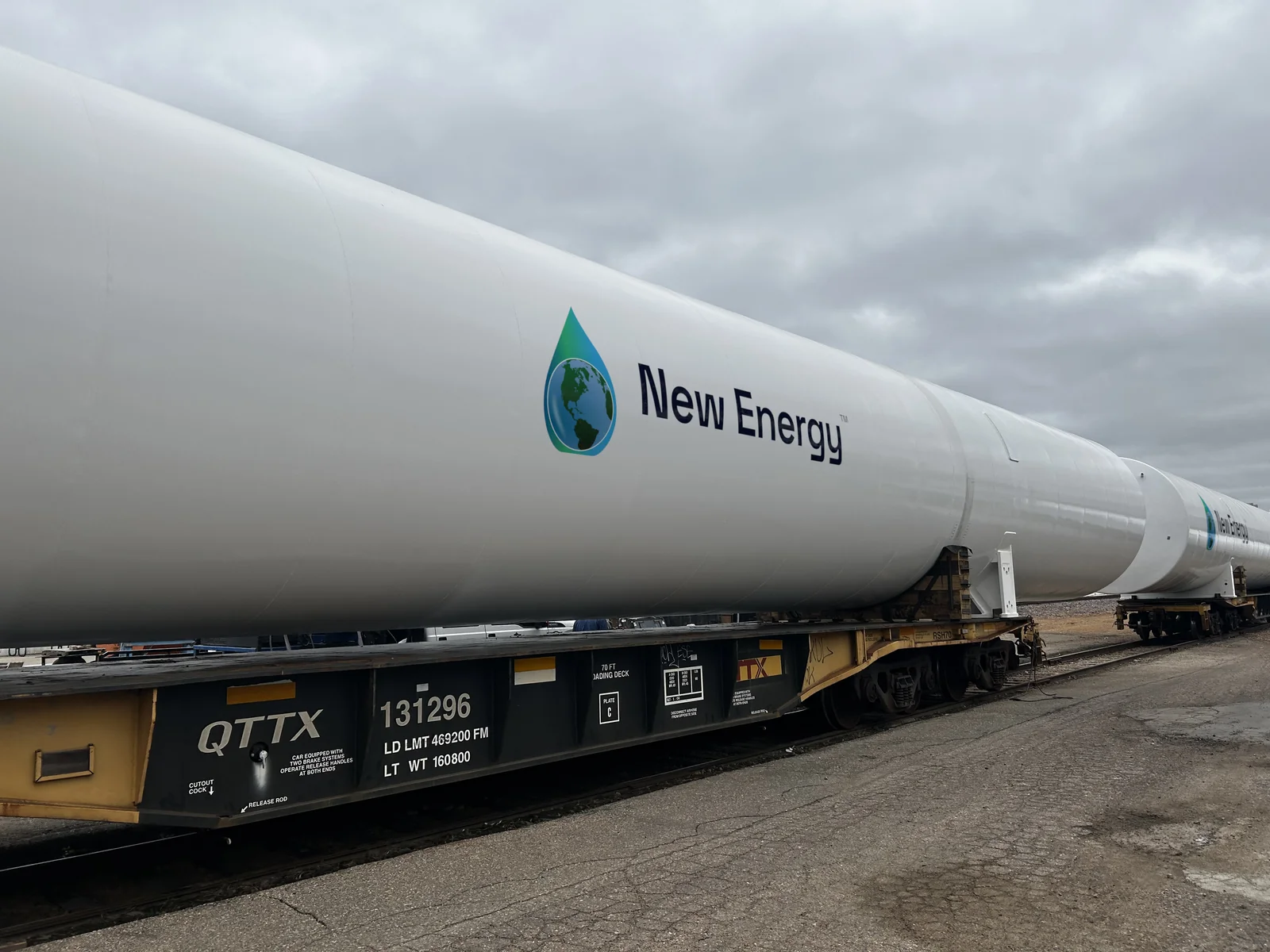
Five LNG storage tanks incorporating GreenER™ Technology have shipped together on a single train to a utility customer in the Southeast. Each one holds 90,000 gallons. Combined, that is 450,000 gallons of LNG storage capacity for that utility’s system. None of the five has an extraction pump, and none has a penetration through the bottom of the tank.
GreenER™ Technology is the cryogenic tank technology New Energy Development Company developed, patented and licenses. Tom Quine, our technical partner, is the inventor.
This post covers why shipping all five at once matters, and what the design takes off a utility’s operating calendar.
What shipped
The tanks are shop-fabricated cryogenic tanks built on GreenER™ Technology, made in a factory and sent out essentially finished. This order is a separate project from our operating reference at Greenville Utilities.
To our knowledge, this is the first time five LNG storage tanks of this size have traveled together on one train.
Built in a shop, economically moved by rail
Shop fabrication was always meant to work this way. The GreenER™ Technology approach builds the tanks in a factory, delivers them by rail or barge, and installs them in weeks, not years. Total system fabrication time currently runs 9 months. Five finished cryogenic tanks on one train is that model at work for a single utility order.
The tank design also shrinks the site work itself. A tank with no bottom penetrations eliminates most of the impoundment and major civil scope a conventional design needs.
No extraction pumps: what comes off the list
Two things a utility operator would expect to find on an LNG system, or on almost any other cryogenic storage and pressurization system, are missing from these tanks. The first is the extraction pump.
A traditional cryogenic tank system moves liquid out with a submerged or separate cryogenic pump sitting in the cold zone. That pump depends on specialized cryogenic seals, and extraction pumps are among the most failure-prone and maintenance-heavy components of an LNG plant.
A pump like that brings its own obligations. It has to be pulled for routine service. Rotating equipment on the send-out side also has to be overhauled between heating seasons, which squeezes maintenance into the months the plant is supposed to be filling.
Tanks built on GreenER™ Technology do not use one. The motive force for moving LNG out of the tank to the vaporizers comes from a simple pressure build system. A controlled vapor-pressure differential pushes the liquid out, so there is no pump in the tank and no extraction pump anywhere on the pad. No power is needed except to move the valves. Our bullet tank article walks through that architecture in detail, and the peak-shaving primer compares pressure-build designs with submerged-pump designs.
What disappears is the whole pump line on the maintenance calendar: the routine pulls, the cryogenic seal work, the overhaul between seasons. Removing the pumps also removes their capital cost and gives the system structurally lower O&M.
No bottom penetrations: what comes off the list
On a conventional tank, bottom penetrations through the tank wall create a leak path that has to be modeled and contained. That is a big part of why those designs carry the impoundment and containment scope they do.
The GreenER™ design uses a full-containment, no-tank-bottom-penetration approach. The inner containment is not pierced through the floor. Withdrawal happens from the top side of the tank, which is what the pressure build system makes possible. U.S. Patent 12,455,047 B2, awarded November 2025, covers the elimination of bottom penetrations and extraction pumps in this storage and pressurization system.
The operating effect is specific. Under 49 CFR 193.2619(c), control systems for internal shutoff valves on bottom-penetration tanks have to be tested every year, and those tanks typically assume civil work sized for a spill of the entire storage volume. A tank with no bottom penetrations has no such valve and can assume a 10-minute design spill. The GreenER™ design also shrinks both PHMSA exclusion zones, for thermal radiation and for flammable vapor, in many cases beyond what the requirements call for. Our winter readiness article covers how the seasonal testing schedule plays out in practice.
Why a utility cares
Utility, space, data center and marine buyers don’t buy adjectives. They buy fewer things that can go wrong on a design day, when it really matters. Every pump that isn’t installed is one nobody has to pull or schedule around, and every pipe that doesn’t go through the floor of the tank is a valve nobody has to test. Pressure build doing the work is the single design decision behind both outcomes.
What happens next
Once on site, the tanks will be set and connected to the pressure build system. The designs align with 49 CFR 193, and with API 620 for larger site-built tanks. New Energy licenses GreenER™ Technology to fabricators and EPC contractors, so it doesn’t depend on one shop or one partner.
If your utility is weighing new peak shaver storage or replacing an aging tank, the GreenER™ Technology overview is a good place to start. When you are ready to talk through a site, reach our team here.
About New Energy Development Company
New Energy Development Company develops, acquires and builds peak-shaving LNG production and storage facilities, and licenses GreenER™ Technology to EPC contractors and tank fabricators. Its founding partners, Hap Ellis, Scott Shields and GreenER™ Technology inventor Tom Quine, bring more than 100 years of combined LNG, cryogenic and energy infrastructure experience.