Getting an LNG Peak Shaver Ready for Winter: What October Decides
The inspections and tests federal rules require before a peak-shaving LNG plant vaporizes its first gallon of the season, why the tank has to be full by the end of October, and what the fall checklist reveals about an aging plant.
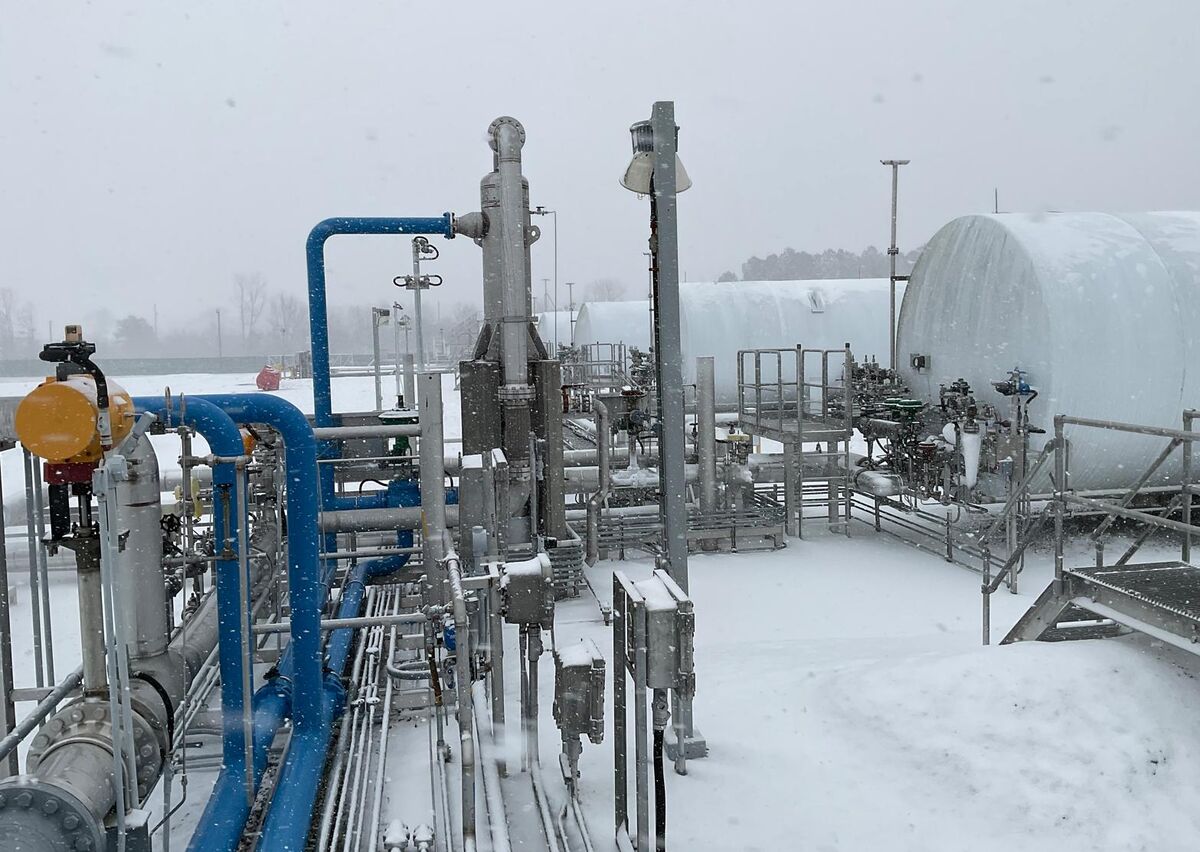
An LNG peak shaver is ready for winter when two things are true by the end of October: the storage tank holds the inventory the utility’s design-day plan counts on, and every control system the vaporization side depends on has been inspected and tested since it was last used. The first is a scheduling problem the liquefier has been working on since spring. The second is a federal requirement with a specific trigger, and October is when both come due.
What follows covers the calendar as the plant sees it, the tests the rules ask for before the first cold snap, and what the fall checklist tends to reveal about a plant that has been running since the 1970s.
Why the tank has to be full by Halloween
The U.S. gas industry runs on two seasons. The Energy Information Administration marks the refill season as April 1 through October 31 and the withdrawal season as November through March, and its November 2025 storage review reports Lower 48 inventories against exactly that October 31 line. Underground storage follows that calendar, and so does a peak shaver, for a simpler reason. Its liquefier is deliberately small. As our peak-shaving primer explains, it is sized to top up storage slowly over months of shoulder-season operation, not to fill the tank in a week.
So the fill curve is fixed early. A liquefier that fell behind in July because of a pretreatment problem or a summer power curtailment cannot make the difference up in October. Boil-off works against it all summer. The number that matters on November 1 is gallons in the tank measured against the design-day send-out the utility has promised its own system, and by mid-October that number is close to final.
What the rule requires before the first send-out
Federal LNG safety rules in 49 CFR 193 treat seasonal equipment as its own case. Section 193.2619(c) requires control systems that are in service but not normally in operation, relief valves and automatic shutdown devices among them, to be inspected and tested once each calendar year at intervals not exceeding 15 months. Then it carves out the seasonal case in paragraph (c)(1): control systems used seasonally, such as for liquefaction or vaporization, must be inspected and tested before use each season.
That sentence is the October job. On a plant that vaporizes only on cold days, every control loop on the send-out side has been idle since March, and the rule does not let it start on a design day without a pre-season test. A few neighboring sections land in the same window:
- Anything idle for 30 days or more. Section 193.2619(b) requires any control system out of service that long to be inspected and tested for operational capability before it returns to service.
- Relief valves. Paragraph (e) requires them to be inspected and tested to verify seat lifting pressure and reseating, not just checked for leaks.
- Backup power. Section 193.2613 requires each auxiliary power source to be tested monthly for operational capability and annually for capacity, with the capacity test sized to start and run every load that source would have to carry in an emergency.
- Transfer hoses. Under section 193.2621, hoses in LNG service are pressure tested once each calendar year and visually inspected before each use. A plant that takes truck deliveries to supplement its liquefier will be using them.
- The tank itself. Section 193.2623 requires inspection or testing for foundation and tank movement, inner tank leakage, insulation effectiveness, and frost heave. Insulation effectiveness shows up directly in the boil-off rate, which is one reason the summer inventory record is worth reading before winter.
- Startup procedures. Section 193.2503(b) requires written startup and shutdown procedures, including performance testing to demonstrate that components will operate satisfactorily in service. The first cold-day send-out is a poor time to learn a vaporizer train cannot hold its outlet temperature.
One item on the 193.2619(c) list deserves a note: control systems for internal shutoff valves for bottom penetration tanks. A tank with a pipe through the bottom of the shell carries an internal valve that has to be tested every year. A tank with no bottom penetrations has no such valve, so that line on the annual list is empty. The rule still applies; there is simply less equipment for it to apply to.
What the fall checklist tells you about an older plant
The primer notes that most of the U.S. peak-shaving fleet was built between the 1960s and the 1990s, which means the pre-season test is being run on equipment that has been through 30 to 50 heating seasons. Three things show up in October that do not show up in July.
The maintenance window closed. Rotating equipment, whether submerged cryogenic pumps or the liquefier’s compressors, has to be overhauled between heating seasons. If the summer outage ran long, the plant enters winter with work deferred to spring. A design without rotating equipment on the storage and send-out side relaxes that constraint, which is one of the four design changes the GreenER™ tank article walks through.
The inventory curve flattened early. A liquefier that once filled the tank by September and now finishes in late October, or does not finish at all, is telling you its pretreatment beds, its refrigeration loop, or both are past their design capacity. That is a repower question, not a maintenance question.
The exclusion zone moved, or the neighbors did. Under section 193.2005, the siting rules reach an existing plant when a tank is relocated or significantly altered by increasing its capacity. Adding storage is the usual answer to a utility whose design day has grown, and our siting article explains why the new tanks, not the old ones, carry the siting question. A parcel that had open land on three sides in 1975 may not have it now.
When to bring us in
The right time is the week the pre-season results come back, while the findings are specific and the capital planning cycle for next year is still open. A utility that already runs a peak shaver is not starting from zero. The Greenville Utilities project, where two of six 80,000-gallon shop-fabricated tanks and the pressurization system are in commercial operation, is a modular addition of exactly that kind, and it reached commercial operation in under 24 months.
Feasibility and siting studies, regulatory support, and owner’s engineer work are all part of our LNG development scope. A copy of this fall’s inspection findings and a design-day number are enough to start the conversation. Sign up for a Lunch & Learn or reach out directly.