Hydrogen and LNG Co-Development Projects: What One Site Carrying Both Involves
What a hydrogen and LNG co-development project shares on one pad, where the two products part ways on engineering and code, and the questions to settle first.
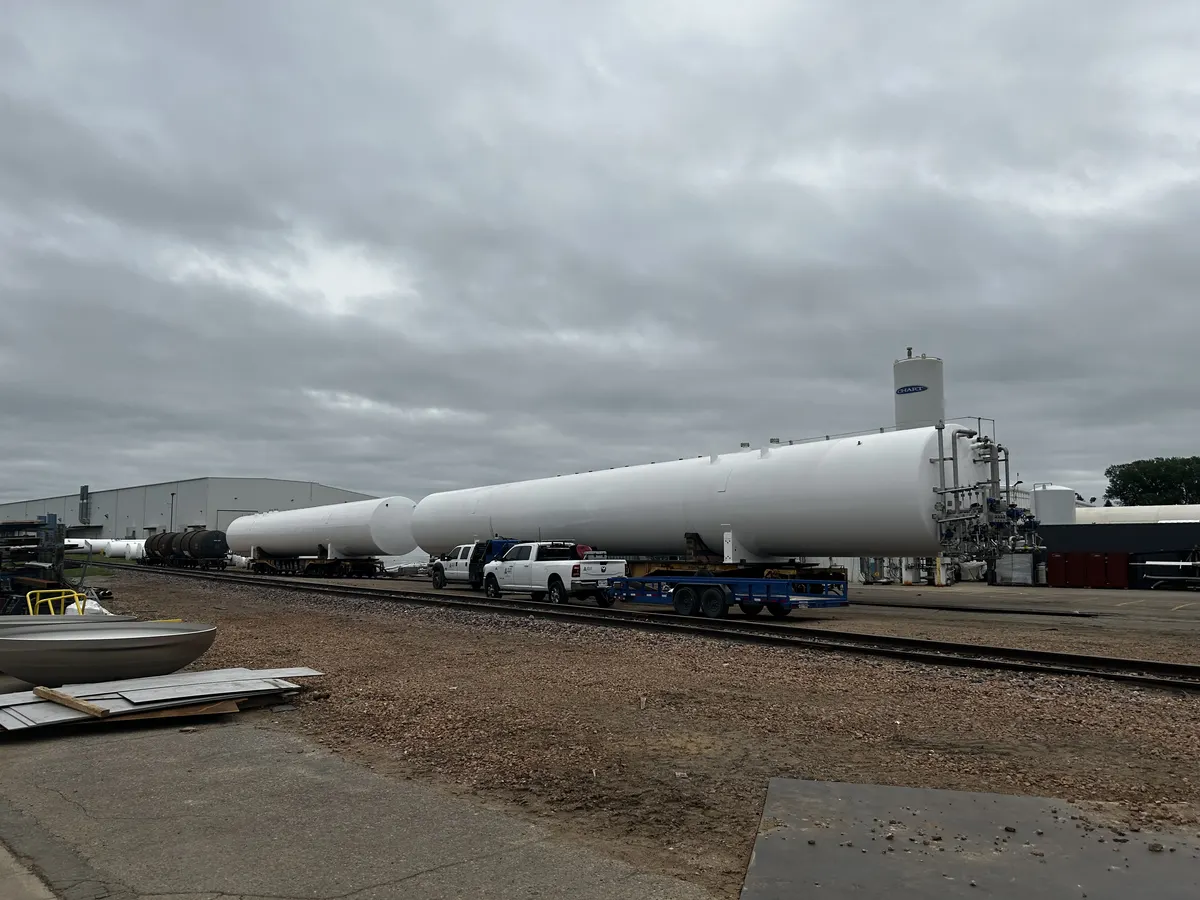
A hydrogen and LNG co-development project is one site engineered from the start to store and dispense more than one cryogenic product. The LNG side does the job a peak-shaving plant has always done for a gas utility. The hydrogen side adds electrolyzers, hydrogen storage, and an offtake path, and it shares the land, the power, the cryogenic handling, and the operating staff with the LNG that is already there.
The version we have engineered looks like this: 200,000 MMBtu of LNG storage plus 23,760 kg per day of hydrogen on roughly 17 acres. Two of those integrated designs are complete, done with McDermott’s CB&I Storage Solutions, and the details sit on our hydrogen and e-NG page.
Why put both on one pad
Most of the cost of a cryogenic site is not the molecule. It is the land, the exclusion-zone work, the civil scope, the power supply, and the people who run it. A utility that has already carried a peak-shaving LNG project through siting has paid for most of that once. Adding hydrogen to the same footprint reuses it.
The hydrogen has somewhere to go, too. The facility designs we completed with CB&I were laid out for grid-scale blending into natural gas pipelines, blending at existing or new power generation, and storage injection into salt caverns and above-ground tanks, with an incremental 15 MW of hydrogen-fueled power generation per site. Those are the same three destinations a gas utility already touches every day.
What the two products share
The storage and pressurization design is the common piece. The GreenER™ tank pushes cryogenic product out of the tank with a pressure-build system instead of extraction pumps, so there are no bottom penetrations through the tank wall. That architecture is engineered for additive deployment of most cryogenic molecules, including e-Methane (e-NG), hydrogen, nitrogen, and propane, alongside LNG, without retrofit. One footprint, more than one product path, phased in as demand shows up.
Additive is the operative word. Hydrogen is not LNG with a different label. It boils at a far lower temperature, the molecule is much smaller, and materials compatibility has to be checked at every joint. A co-development project does not pour hydrogen into an LNG tank. It puts hydrogen storage built on the same design principles next to the LNG storage, on the same pad, under one operating plan.
Where they part ways
The rulebook splits. The LNG side lives under 49 CFR 193, which pulls in NFPA 59A, with tanks designed to API 620. The hydrogen side has its own code, NFPA 2, the Hydrogen Technologies Code. Siting and exclusion-zone modeling have to be run for both products, and the two sets of setbacks do not always land in the same place on the drawing.
The power question changes. An LNG peak shaver needs power for liquefaction. A 50 MW hydrogen plant needs power for the electrolyzers, and that load is the single largest operating input on the hydrogen side. Our integrated designs carry an optional 11 to 70 MW of solar tied to electric-drive liquefaction. The companion PER™ pipeline energy recovery patent recovers waste pressure and heat from existing gas pipelines and turbines and turns it into process or electrical power. Power Magazine’s April 2021 coverage of the CB&I engineering quoted Scott Shields on that pairing: on an integrated project, pipeline energy recovery can reduce electrolysis power input costs “to as low as $0.” Whether that holds on a given site depends on what pressure and heat that site actually has to recover, which is a survey question, not an assumption.
The offtake is different. LNG on a peak-shaving site has one customer, the utility’s own distribution system on a design day. Hydrogen needs a contracted destination before the electrolyzers are sized, and a blending program at a pipeline or a power plant runs on its own approvals.
The sequence, in practice
The designs are modular and expand in increments, so the two halves do not have to be built in one pass. For most utilities the natural order is to carry the LNG peak shaver first, because it answers a near-term reliability need and, in regulated service, its capital generally has a path through the rate case, then bring hydrogen onto the pad when an offtake agreement is in hand. The site is laid out for both from day one so the second phase is an addition, not a redesign.
For a sense of what the LNG half looks like in operation, the Greenville Utilities project has two of six 80,000-gallon tanks plus the pressurization system in commercial service.
Five questions to settle before engineering starts
- Who takes the hydrogen, and on what terms? The offtake sets the electrolyzer size, and the electrolyzer size sets the power demand.
- Where does the power come from? Grid, on-site solar, pipeline energy recovery, or a mix. This number moves the operating cost more than any other.
- What does the parcel allow for two sets of exclusion zones? Roughly 17 acres is what our reference design needs. A tighter site may still work, but it has to be modeled, not assumed.
- Which product goes first, and what has to be roughed in for the second? Pad, power, and piping corridors are cheap to reserve at the start and expensive to add later.
- Who operates it on day one? A site with two cryogenic products needs a training plan before commissioning, not after.
When to bring us in
The right time is before the parcel is chosen, while the exclusion-zone math can still change where things go. We work three ways: full-scope project development as owner’s engineer or design-build, project consulting for the assessment and board-ready advisory work, and co-investment capital where the project benefits from it. Most engagements blend two of the three.
If you are weighing hydrogen against a peak-shaving project you already have on the drawing board, sign up for a Lunch & Learn or reach out directly. There is no charge for a first conversation.