Pump-Free Propellant Storage for Methane and LOX Launch Sites
Launch vehicles running on liquid methane and liquid oxygen need large cryogenic tank farms and fast, repeatable transfer. Here is how GreenER™ Technology moves propellant by tank pressure, with no pumps in the fill line and no bottom penetrations.
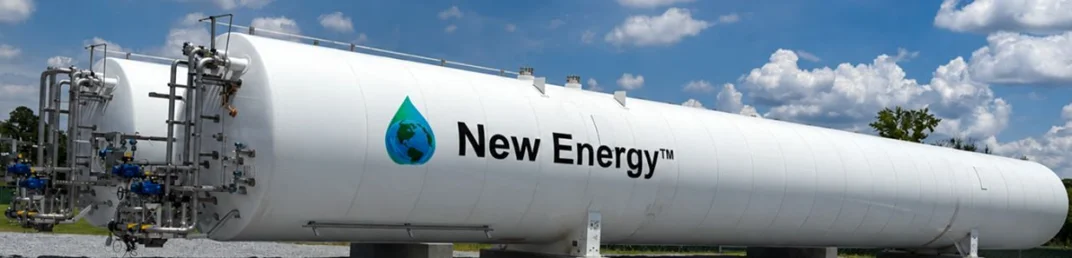
The newest generation of launch vehicles burns liquid methane and liquid oxygen. That choice shows up on the ground long before it shows up in the sky. A methane and LOX pad needs a tank farm holding tens or hundreds of thousands of gallons of cryogenic liquid, and it needs to move that liquid into the vehicle on a tight, repeatable timeline.
Most of that infrastructure was designed around rotating equipment. GreenER™ Technology (U.S. Patent No. 12,455,047 B2) takes the rotating equipment out.
The pump is the part that fails
A conventional cryogenic tank farm moves liquid with extraction pumps. Those pumps sit in the cold zone, depend on cryogenic seals and bearings, need power, starters, VFDs and controls, and usually come in pairs so one can carry the load when the other is down.
On a launch pad, every one of those parts is a way to scrub. A pump that will not prime, a seal that leaks, a VFD that trips during the fill: the vehicle is ready and the ground is not.
Pressure does the work instead
GreenER™ Technology uses a single pressure-build tank and vaporizers to raise and hold vapor pressure across a group of storage tanks through a common vapor connection. That pressure pushes the liquid out to the vehicle. Nothing rotates in the withdrawal path.
What comes off the pad’s equipment list:
- Liquid extraction pumps and their redundant spares
- The pump electrical package: motors, starters, VFDs, cabling and backup power
- Pump procedures, cooldowns, inspections and rebuilds
- The extraction pump as a single point of failure in the fill line
What replaces it is valves, instrumentation, pressure control and static equipment. Sendout depends on a designed tank-pressure envelope instead of on pump and electrical availability.
Nothing through the bottom of the tank
Every nozzle on a GreenER™ tank comes through the top. There are four of them: a common vapor connection, boil-off, liquid in through a spray bar that runs most of the tank’s length, and liquid in and out by bottom capture without a bottom penetration.
Bottom penetrations are where conventional tanks raise the hardest questions: pad safety reviews, NFPA 59A compliance questions, more civil work and more acreage for containment. Removing them shrinks the containment scope and the footprint, which matters on a pad where every acre is already spoken for.
One architecture for every cryogen on the pad
A launch site rarely stores just one liquid. The same storage and pressure-build approach applies to liquid oxygen, liquid methane and LNG, liquid nitrogen and liquid hydrogen. Oxygen runs in an oxygen-service configuration on the same principle. One design family across the tank farm means one set of procedures to train on and one approach to maintain.
Built in a shop, from more than one shop
GreenER™ tanks are shop-fabricated and shipped finished by rail or barge. Total system fabrication time can be as early as 9 months. The design is licensed to several qualified fabricators, so a launch program adding storage is never waiting on a single shop’s queue.
That matters when a pad needs to grow. A site moving toward faster turnarounds usually needs more propellant on hand, and adding tanks that arrive finished is a much shorter project than adding a field-erected tank and its pump skids.
Proven on a utility grid first
The same technology is in commercial operation today at Greenville Utilities, where two of six 77,000-gallon tanks and the GreenER™ pressurization system move LNG by pressure with no in-tank pumps. A separate order of five tanks is loaded on a single train for a utility customer in the Southeast.
Utilities hold storage to a reliability standard that looks a lot like a launch program’s: when demand peaks, the liquid has to move, every time.
How we work with launch teams
New Energy Development Company works on the owner’s side, alongside a launch company’s own engineers and vendors. A first assignment can be a single decision: a feasibility study, a pre-FEED basis of design, owner’s engineer support on a procurement, or readiness work before startup.
Engineers evaluating a site can read more on our space and launch page, including how to request the technical brief with tank series, fill-rate sizing and nozzle architecture.